Quick Facts
- Training Time: Humanoid robots can now master complex sports skills using only 5 hours of motion capture data.
- Performance Metric: The system achieved a 96.5% overall return success rate in real-world tennis testing.
- Accuracy Benchmark: The robot maintained a 90.9% accuracy rate for forehand shots across 10,000 trials.
- Core Technology: LATENT AI utilizes motion primitives to translate imperfect human data into robotic motion.
- Hardware Specs: The Unitree G1 humanoid robot features high-torque actuators and costs approximately $16,000.
- Reaction Speed: The system enables autonomous, decision-driven adjustments within milliseconds during live rallies.
Galbot has unveiled a revolutionary approach to humanoid robot training, enabling machines to master professional-level athletic skills like tennis in just five hours. Using the LATENT AI framework, the Unitree G1 humanoid achieved a staggering 96.5% return rate, signaling a shift from months of simulation to hours of real-world motion learning.
The 5-Hour Breakthrough: Training with Imperfect Data
For years, the robotics industry has faced a formidable challenge known as the Data Wall. Traditionally, teaching a robot to perform a complex physical task required months of high-fidelity simulations or thousands of hours of perfectly cleaned data. This made humanoid robot training an expensive, slow, and often rigid process. If the simulation wasn't perfect, the robot would fail in the real world.
Galbot’s LATENT system changes the narrative by embracing imperfection. Instead of requiring professional athletes to move with clinical precision in a lab, researchers collected 5 hours of motion capture data from five amateur players. This is the robotic equivalent of learning how to play tennis by watching TikTok videos of people at the local park rather than studying every frame of a Wimbledon final.
This shift from pristine simulation to real-world imperfect human data is significant. It allows the robot to understand the messy, unpredictable nature of human movement. By training on amateur data, the robot learns to be reactive rather than just following a script. In live testing, this allowed the robot to sustain rallies of more than 25 shots against human opponents who weren't holding back. The system is no longer just executing a pre-programmed swing; it is making autonomous, decision-driven adjustments within milliseconds to ensure the racket meets the ball.
Inside the LATENT AI Framework: Motion Primitives
To understand how Galbot achieved this, we have to look under the hood at the technical architecture. The LATENT AI framework, developed through a collaboration involving Tsinghua University, Peking University, and the Shanghai AI Laboratory, relies on a concept called motion primitives.
Think of motion primitives as the "alphabet" of movement. Instead of trying to teach the robot a "tennis swing" as one giant, complex block of code, the system breaks it down into smaller, reusable fragments. These include specific footwork patterns, torso rotations, and arm extensions. By learning these basic fragments, the robot can then sequence them together in real-time to respond to wherever the ball lands on the court.
This method solves the problem of biomechanical coordination. When a human plays tennis, they don't just move their arm; their entire body shifts to maintain balance while generating force. The LATENT AI framework uses reinforcement learning and whole-body control to ensure the robot remains stable. Even when the Unitree G1 lunges for a wide shot, its internal system manages dynamic balance and proprioceptive feedback to prevent it from toppling over.
By focusing on these fundamental building blocks, the researchers have created a framework for rapid skill acquisition. The same logic used for tennis could theoretically be applied to other sports or even household chores, provided the system has a few hours of human motion to analyze.
Hardware Spotlight: Unitree G1 Performance Benchmarks
While the software provides the brains, the Unitree G1 serves as the brawn. Priced at a relatively accessible $16,000, the G1 is quickly becoming the gold standard for researchers looking for athletic humanoid robot capabilities without the multi-million dollar price tag of a Boston Dynamics Atlas.
The G1 is equipped with high-torque actuators that allow for the explosive movements necessary for sports. In a series of 10,000 trials, the Galbot-trained humanoid achieved a 96.5% overall return success rate. More impressively, it maintained a 90.9% accuracy rate for forehand shots, placing the ball consistently within the court boundaries.
| Metric | Unitree G1 (LATENT AI) | Traditional Humanoid (Scripted) |
|---|---|---|
| Training Time | 5 Hours | 100+ Hours (Sim) |
| Success Rate | 96.5% | < 70% |
| Reaction Time | Milliseconds | Seconds |
| Data Source | Amateur Human MoCap | High-Fidelity Simulation |
| Adaptation | High (Reactive) | Low (Pre-planned) |
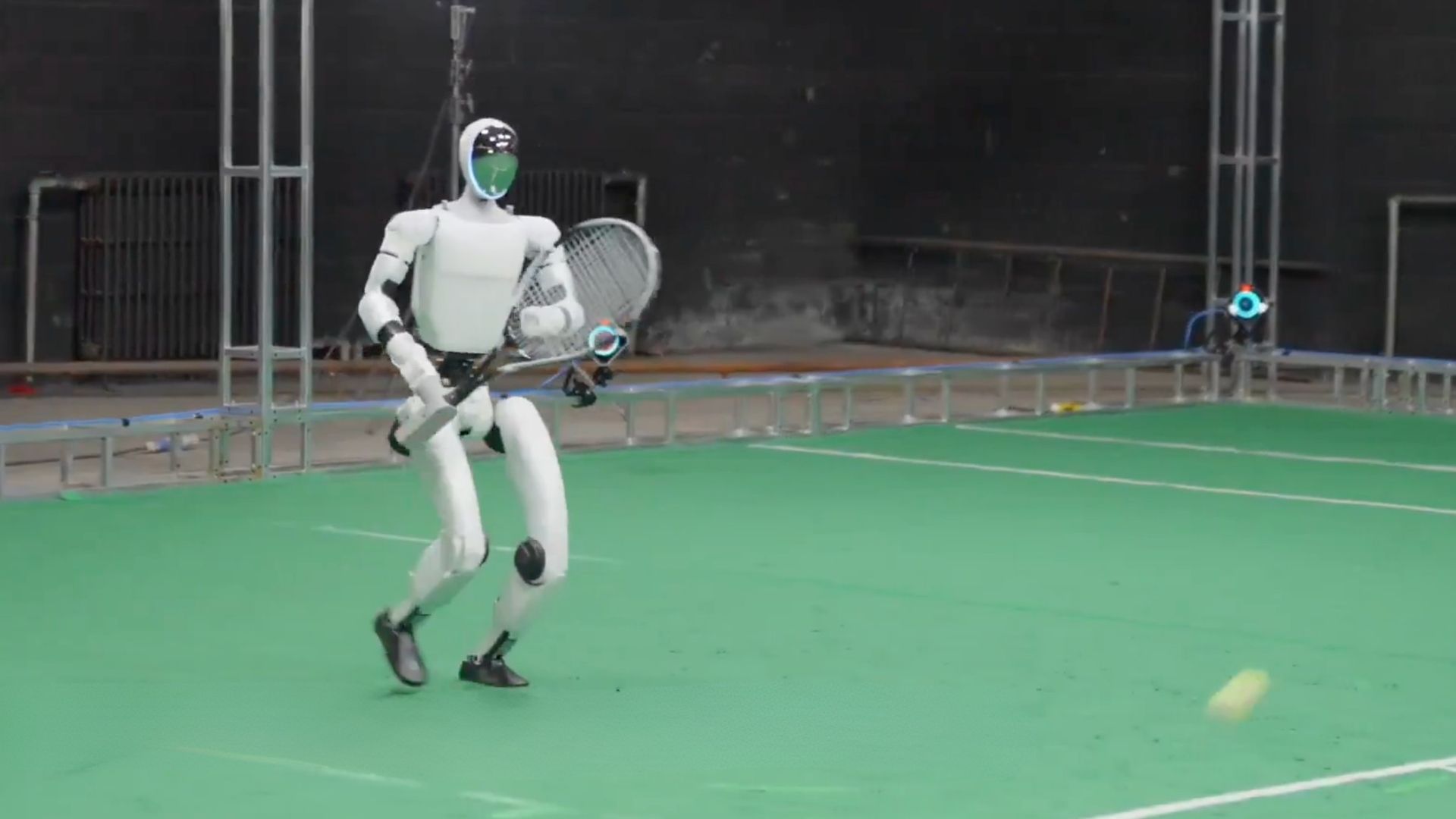
The robot’s ability to handle ball speeds exceeding 15 meters per second is a testament to the hardware-software synergy. Unlike earlier models like the UBTech Walker S2, which often struggle with the rapid weight shifts required for racket sports, the G1 handles these transitions with surprising fluidity.
Scaling the Future: From Tennis to General Athletics
The success of Galbot’s LATENT AI in tennis is just the beginning. The roadmap for this technology involves moving from simple ball-return drills to strategic, multi-agent play. Imagine a future where your robot isn't just a practice partner but a coach that can analyze your swing and play at exactly 10% better than your current level to help you improve.
However, there are still hurdles to clear. Currently, many of these high-speed tests rely on external motion capture systems to provide predictive ball tracking. For a robot to be truly autonomous in a home or public park, it must transition to active vision. This means the robot would use its own "eyes" (cameras and LiDAR) to track the ball and the opponent simultaneously.
Improving humanoid robot reaction time for sports is the next major frontier. While the G1 is fast, it currently uses a fused racket—meaning the racket is essentially part of its hand to ensure stability. Future iterations will likely feature more advanced dexterous grasping, allowing the robot to switch between different sports equipment or household tools seamlessly.
The ultimate goal is scaling humanoid robot training from tennis to other sports like badminton, table tennis, or even soccer. Because the LATENT AI system relies on motion primitives rather than sport-specific code, the transition to new activities should be significantly faster than previous methods. We are entering an era where training athletic robots with imperfect human data will be the standard, making "pro-level" robotic assistants a reality for the average consumer.
FAQ
How long does it take to train a humanoid robot?
Using traditional methods involving complex simulations, training can take weeks or months. However, with the new LATENT AI framework, a humanoid can learn complex athletic skills like tennis returns in as little as five hours using motion capture data from human amateurs.
Can humanoid robots learn by observing humans?
Yes, this is a core component of recent breakthroughs. Systems like Galbot's LATENT AI use data collected from humans wearing motion capture suits. The AI then decomposes these human movements into motion primitives that the robot can replicate and adapt to real-world scenarios.
What challenges exist in training robots for real-world environments?
The primary challenge is the sim-to-real gap, where movements that work in a computer simulation fail in the real world due to friction, gravity, or unpredictable human behavior. Additionally, robots must maintain dynamic balance while performing high-speed tasks, which requires immense computational power and high-torque actuators.
Is virtual simulation used for humanoid robot training?
While virtual simulation is still used to refine safety and basic motor skills, the trend is shifting toward reinforcement learning based on real-world human data. This helps the robot handle the "messiness" of reality that simulations often fail to capture accurately.
What hardware is required for training humanoid robots?
Athletic training requires a humanoid platform with high-torque actuators for fast movement, a sophisticated sensor suite (including LiDAR and cameras), and powerful onboard processing for millisecond-level decision making. Models like the Unitree G1, costing around $16,000, are currently the primary hardware used for this type of research.