Quick Facts
- 2026 Status: Commercial hybrid systems like the Cortical Labs CL1 are now operational for specialized research.
- Core Performance: Biological agents have shown a leap from 4.5% to 46% success rates in standardized cart-pole benchmarks.
- Energy Efficiency: Living neural networks operate with energy requirements orders of magnitude lower than traditional GPU-based clusters.
- Learning Speed: Biological systems demonstrate a significant performance gap over digital agents, often learning new environments in minutes rather than hours.
- Market Outlook: The global reinforcement learning market is projected to expand from an estimated USD 12.43 billion in 2025 to USD 111.11 billion by 2033.
- Primary Constraint: Current systems face a roughly 45-minute memory gap, limiting long-term complex task retention in isolated tissues.
Biological AI involves using lab-grown neural tissues, such as brain organoids, to perform computational tasks through reinforcement learning. Unlike traditional silicon-based hardware, these systems utilize the intrinsic adaptive capacity of cortical tissue to solve complex problems by applying bio-electrical feedback as rewards or punishments to refine goal-directed behavior.
The Shift to Wetware: Why Biological AI Matters in 2026
As a hardware editor, I have spent decades tracking the roadmap of silicon. We have moved from micrometers to nanometers, squeezing every possible drop of performance out of transistors. But as we enter 2026, the industry is hitting a wall that isn't just about heat—it's about the sheer energy cost of intelligence. Large Language Models and deep reinforcement learning agents require massive server farms. In contrast, biological computing systems offer a path toward low-wattage, high-efficiency intelligence that mimics the human brain’s own architectural elegance.
The movement toward wetware computing is driven by the realization that biological AI can handle certain types of learning with far less data. While a digital agent might need a million iterations to learn how to navigate a maze, a small cluster of neurons can often figure it out in a fraction of the time. This efficiency is the reason why researchers are moving beyond the simulation of neural networks on chips and are instead using actual living cortical tissue as the processor itself. By integrating these biological units into digital frameworks, we are seeing the birth of the first true bio-silicon hybrid computers.
Training the Brain: Reinforcement Learning via Bio-Electrical Feedback
To understand how we train a dish of cells to play a game or balance a digital pole, you have to look at the AI-as-coach paradigm. In this setup, the biological AI acts as the "player," while a traditional software layer acts as the "coach." This coaching mechanism leverages neural plasticity and synaptic adaptation to guide the growth and connectivity of the cells.
The process of how to train brain organoids for reinforcement learning tasks begins with a closed-loop system. When the organoid makes a decision—represented by a specific pattern of neural firing—the digital interface monitors this activity. If the action leads toward the desired goal, the system delivers a structured pulse of bio-electrical feedback mechanics that the neurons perceive as a "reward" or a signal to strengthen those specific connections. If the action is "wrong," the feedback is chaotic or inhibitory, serving as a punishment.
Over time, the cortical tissue reorganizes itself. This isn't just software changing a weight in a matrix; it is physical matter changing its shape and electrical sensitivity. This use of bio-electrical feedback mechanics allows the system to achieve goal-directed learning without the need for traditional sensory organs or dopamine. It is reinforcement learning in its most primal, structural form.
Benchmarking Performance: Biology vs. Silicon
When we talk about performance, we usually talk about TFLOPS or frames per second. But in the world of biological computing systems vs traditional AI hardware comparison, the metrics change to sample efficiency and energy-per-inference. In recent experimental comparisons, synthetic biological intelligence systems utilizing live neural cultures have demonstrated higher sample efficiency than state-of-the-art deep reinforcement learning algorithms, such as PPO and DQN.
For example, when playing a simplified version of 'Pong,' a digital reinforcement learning agent might require ten thousand trials to reach a baseline of competency. A biological agent can often reach that same level in under twenty minutes. This gap is even more pronounced in spatial awareness tasks. Biological animals can effectively learn a new environment in less than ten minutes, whereas artificial reinforcement learning agents typically require thousands of exploratory trials to achieve similar results.
| Metric | Silicon RL (PPO/DQN) | Biological AI (Organoids) |
|---|---|---|
| Power Consumption | High (Kilowatts) | Extremely Low (Microwatts) |
| Learning Efficiency | Low (Millions of data points) | High (Dozens of data points) |
| Adaptive Capacity | Rigid (Requires retraining) | Fluid (Intrinsic plasticity) |
| Environmental Needs | Cooling fans/Server racks | Incubators/Nutrient media |
While silicon still wins on raw processing speed and reliability for mathematical tasks, the biological AI shows a clear advantage in tasks requiring rapid adaptation to novel environments. This is why practical applications of biological AI in engineering problems are currently focusing on robotics and edge computing, where power is limited but the environment is constantly changing.
Hardware Foundations: 3D Bioelectronics and Infrastructure
Building a biological AI isn't just about the cells; it’s about the interface. The biological AI research infrastructure requirements for 2026 are becoming more standardized, moving away from "mad scientist" lab setups to professional-grade hardware. The core of this is the high-density microelectrode array.
Key components of the 2026 infrastructure include:
- CMOS Arrays: These chips, like those developed at UC Santa Barbara, feature over 26,400 electrodes capable of both recording and stimulating individual neurons simultaneously.
- BrainDance Software: A specialized platform used for decoding electrophysiology data in real-time, allowing researchers to see the "thought patterns" of the organoid as it learns.
- Microfluidic Life Support: Automated systems that deliver oxygen and nutrients to the cortical tissue, ensuring the "processor" stays alive for months at a time.
- 3D Bioelectronic Scaffolds: Instead of growing cells on a flat dish, these scaffolds allow for 3D neural networks, which more closely mimic the complexity of a natural brain.
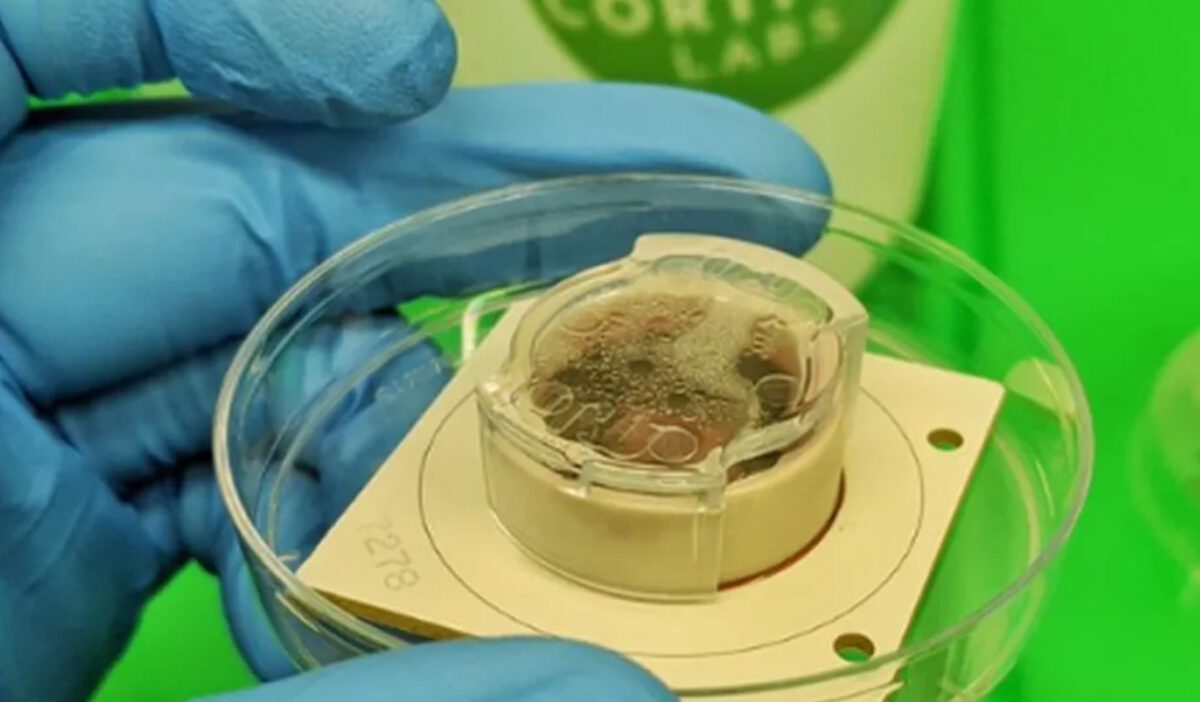
This digital-to-biological interface is where the real magic happens. By using neuromorphic engineering principles, we can translate digital code into electrical patterns that a living cell can understand, and vice versa.
The Commercial Reality: CL1 and FinalSpark
We are no longer just talking about university experiments. Companies like Cortical Labs have launched the CL1, a commercial-grade biocomputer that integrates living neurons into a standard rack-mount chassis. Meanwhile, FinalSpark has created a remote platform that allows developers to run experiments on live neurons over the cloud.
The current hurdle for these biological computing systems is the "memory gap." While these organoids are great at short-term tasks, they currently struggle to retain information for more than about 45 minutes once the stimulus is removed. Overcoming this requires more advanced neuro-engineering to encourage long-term potentiation—essentially creating the biological version of a hard drive.
Ethical Thresholds and Future Frontiers
As we push the boundaries of biological AI, we inevitably run into the wall of neuroethics. When does a collection of cells in a dish move from being a "biological processor" to something that possesses a threshold of consciousness? While current organoids lack any form of sensory input or higher-order brain structures like a thalamus, their ability to perform goal-directed learning raises questions about the future of biological cybernetics.
For now, the focus is not on replacing your desktop CPU with a jar of brain cells. Instead, the goal is to use these systems for advanced drug testing, modeling neurological diseases, and creating ultra-efficient controllers for robotics. By 2026, we are seeing the first steps into a world where the distinction between "hardware" and "life" begins to blur.
FAQ
What is biological AI?
Biological AI is a field of computing that uses living neural tissues, often grown from stem cells into brain organoids, to perform computational tasks. It blends synthetic biology with traditional computer science, using living cells as the primary processing unit rather than silicon transistors.
How does biological AI differ from traditional artificial intelligence?
Traditional AI relies on digital algorithms and silicon hardware to simulate intelligence through mathematical weights. Biological AI uses the physical neural plasticity and synaptic adaptation of living cells to learn and process information, often requiring far less energy and fewer data samples to achieve results.
What are the main benefits of biological computing?
The primary benefits include extreme energy efficiency, high sample efficiency for learning, and the ability to model human neural responses for medical research. These systems can learn complex tasks in minutes that might take a digital agent thousands of trials to master.
Is biological AI more energy efficient than silicon-based chips?
Yes, biological computing systems are significantly more energy-efficient. A human brain operates on about 20 watts of power, while a silicon-based supercomputer performing similar complex tasks requires megawatts. This efficiency is mirrored in small-scale biological AI systems.
How are living brain cells used in biological AI systems?
Living cells are placed on microelectrode arrays that act as a bridge between the biological and digital worlds. Software sends electrical signals to the cells to provide data or feedback, and the cells' response is recorded as output, creating a closed-loop system for reinforcement learning.
What are the ethical concerns surrounding biological artificial intelligence?
The main concerns involve neuroethics and the potential for these systems to reach a state of consciousness or sentience as they become more complex. There are also debates regarding the source of the biological material and the long-term implications of merging living tissue with machines.