Best Soundbars for Music: Key Specs & Buying Guide
Choosing the right audio gear is often a balancing act between convenience and raw performance. For years, the consensus among audiophiles was that soundbars were strictly for cinema—great for making explosions rattle your windows but lacking the nuance required for a delicate jazz recording. However, the landscape has shifted. Modern engineering has allowed these slim units to rival traditional stereo setups in surprising ways. When you are hunting for the best soundbars for music, the secret lies in looking past the marketing fluff and diving deep into the technical specifications that actually dictate tonal accuracy and clarity.
Quick Facts
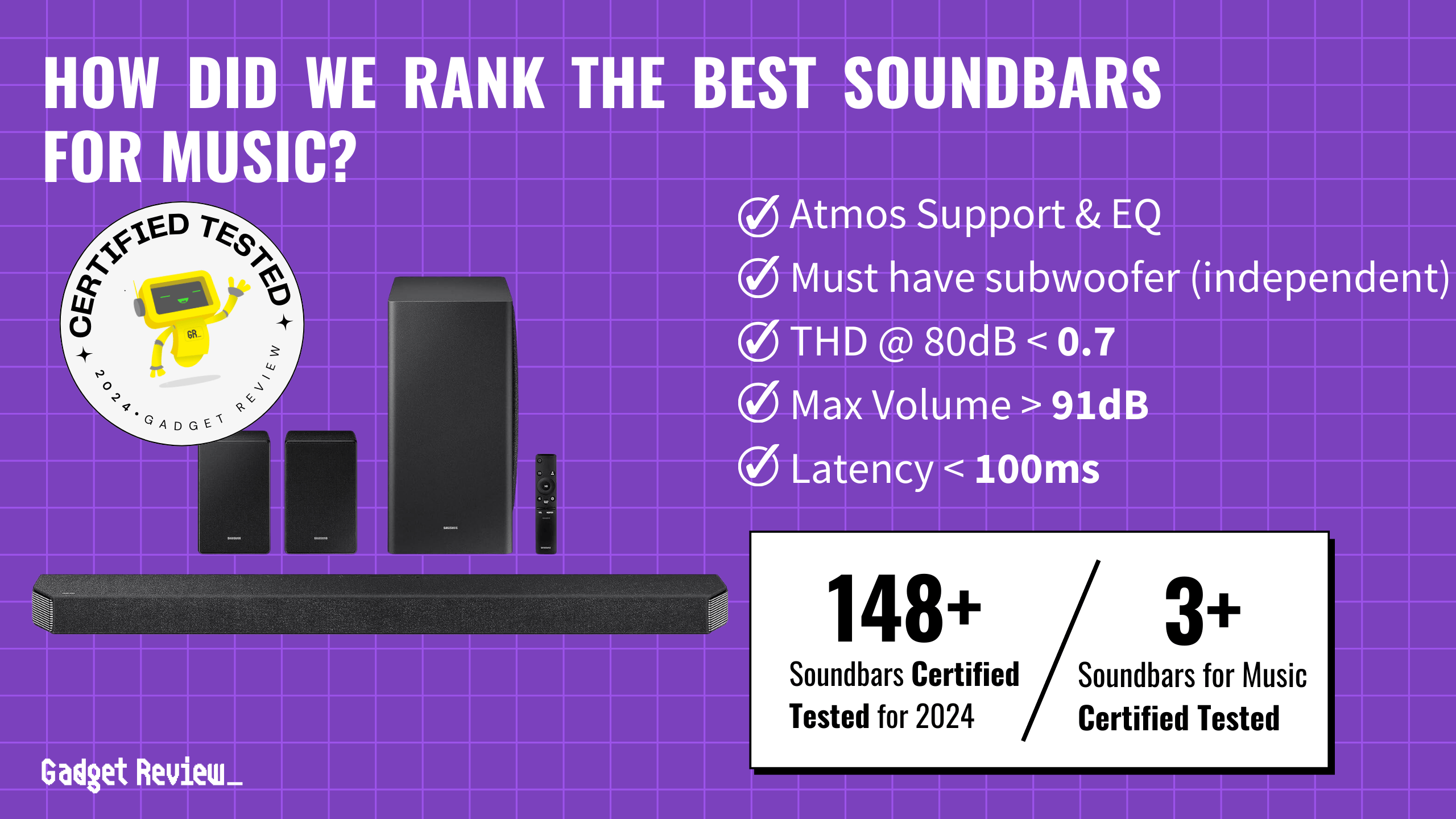
- Distortion Threshold: Total harmonic distortion (THD) should remain below 0.7% at 80dB to ensure clean signal reproduction.
- Volume Floor: A minimum of 91dB maximum output is required to provide enough headroom for dynamic musical peaks without clipping.
- Bass Extension: Look for a low end roll off for bass heavy music that reaches below 45 Hz to capture the foundational notes of kick drums and bass guitars.
- Connectivity: Wi-Fi is the preferred protocol over Bluetooth to support lossless 1411kbps FLAC files and high-resolution streaming.
- Spatial Audio: Support for Dolby Atmos Music and 24-bit/96kHz Hi-Res audio is essential for modern immersive listening.
- Hardware: An independent subwoofer and a customizable equalizer are mandatory features for achieving true high fidelity audio soundbars performance.
- Key Pick: For the ultimate music experience, prioritize a system with a THD under 0.7%, a dedicated wireless subwoofer, and integrated Wi-Fi for uncompressed playback.
When looking for soundbars for music, audio fidelity is the priority. Unlike movies where dialogue and rumble matter most, music requires precise tonal accuracy and low distortion. To find the best soundbars for music, you must look at technical specs: total harmonic distortion (THD) should be under 0.7%, and frequency response should reach below 45 Hz for deep bass. This guide breaks down the essential high-fidelity audio soundbars metrics to help you build the perfect home audio ecosystem.
The Science of Fidelity: THD and Volume Headroom
In the world of high-end audio, the enemy is always distortion. When we talk about soundbar total harmonic distortion, we are measuring the percentage of unwanted harmonics that the equipment adds to the original audio signal. For a casual movie watcher, a bit of grit in an action sequence might go unnoticed. For a music lover, however, even minor distortion can lead to listening fatigue and a loss of instrumental separation. Maintaining a low soundbar total harmonic distortion for music quality—ideally under 1% and preferably below 0.7%—preserves the integrity of the recording and ensures that high-frequency details like the shimmer of a cymbal remain crisp.
Volume is about more than just how loud the unit can get; it is about headroom. If a soundbar has a maximum output of only 85dB, it will likely be struggling and distorting when you try to fill a room with sound. A volume floor of at least 91dB ensures that the internal amplifiers aren't being pushed to their absolute limits during your favorite crescendos. This technical accuracy is what separates choosing high fidelity audio soundbars for audiophiles from buying a generic living room speaker. When the hardware has breathing room, the mid-range response stays open and natural, allowing vocals to sit perfectly in the center of the mix.
Beyond the numbers, the way a soundbar handles power affects its dynamic range. Music is a series of quiet moments followed by sudden bursts of energy. If the digital-to-analog converter and the power supply are subpar, those transitions will feel compressed and flat. High fidelity audio soundbars use sophisticated power management to ensure that when a snare hit occurs, it has the necessary "snap" without bleeding into the frequencies of the surrounding instruments.
Decoding the Soundbar Frequency Response Guide
Understanding how to read soundbar frequency response for music is perhaps the most useful skill a buyer can have. Most manufacturers will claim a range of 20Hz to 20kHz, but without a decibel tolerance (like +/- 3dB), those numbers are virtually meaningless. To get a true sense of how a system will sound, you need to look at the three-tier breakdown:
- Bass (20Hz – 250Hz): This is where the energy lives. Most standalone soundbars struggle here, which is why a soundbar low end roll off for bass heavy music is so critical. If the system rolls off at 60Hz or 70Hz, you are missing the "thump" of the kick drum and the deep growl of a synth-bass. A roll-off below 45Hz is the gold standard for music.
- Midrange (250Hz – 4kHz): This is the heart of the music. Vocals, guitars, and pianos live in this space. A flat, neutral midrange response ensures that the artist’s voice sounds like it’s in the room with you, rather than coming out of a plastic box.
- Treble (4kHz – 20kHz): This provides the air and clarity. Too much treble leads to sibilance (that annoying "hissing" on S-sounds), while too little makes the music sound muffled.
A comprehensive soundbar frequency response guide helps you identify if a unit has "V-shaped" tuning (boosted bass and treble) or a more "neutral" profile. For purists, a neutral profile is usually better, as it allows the music to sound exactly as the producer intended. However, having a built-in equalizer is a huge advantage, as it allows you to compensate for the specific acoustics of your room, which might absorb or reflect certain frequencies more than others.
Wireless Protocols: Why Wi-Fi Beats Bluetooth for Music
Connectivity is often where even the most expensive soundbars for music fail the audiophile test. While Bluetooth is incredibly convenient, it is inherently limited by bandwidth. Standard Bluetooth codecs compress audio significantly, often capping out around 320kbps. This is fine for podcasts, but it strips away the depth and "air" found in high-resolution music files.
This is why Wi-Fi connectivity is a critical specification for high-fidelity music listening. Wi-Fi has a much broader bandwidth, allowing for the transmission of lossless 1411kbps FLAC files and even 24-bit Hi-Res audio. The industry has recognized this shift; currently, more than 70% of soundbars sold in the United States now include both Wi-Fi and Bluetooth streaming capabilities to accommodate diverse wireless audio sources.
Furthermore, integrating your soundbar into a home audio ecosystem via Wi-Fi allows for uncompressed playback through protocols like Spotify Connect, Tidal Connect, and Apple AirPlay 2. These wireless connectivity options for high quality music streaming ensure that your phone acts only as a remote, while the soundbar pulls the data directly from the cloud at maximum quality.
For those interested in the future of audio, Dolby Atmos soundbars for immersive music listening are becoming the new benchmark. Beyond traditional stereo, Atmos Music creates a 3D soundstage where instruments can be placed above or behind the listener. This isn't just a gimmick; it provides better spatial imaging for live recordings and complex orchestral compositions. As of 2026, music streaming is estimated to account for 20% to 25% of total soundbar demand, largely driven by these integrated Wi-Fi and multi-room features that cater to serious listeners.
Essential Hardware: Subwoofers and Calibration Software
The physical driver architecture of a soundbar is its destiny. You cannot fake physics. Because soundbars are inherently slim, their internal drivers are small. Small drivers are excellent for midrange and treble but are incapable of moving enough air to produce deep, resonant bass. This is why I always tell readers that an independent subwoofer is non-negotiable for a music-first setup. A dedicated sub takes the heavy lifting away from the main bar, allowing the smaller drivers to focus on tonal accuracy in the mids and highs.
Equally important is the digital brain inside the unit. Calibration software has become a game-changer for home audio. Every room has different acoustics—hardwood floors reflect sound, while heavy curtains absorb it. Modern high-fidelity audio soundbars often include room-tuning technology (like Sonos Trueplay or Samsung SpaceFit). These systems use microphones to measure how sound bounces off your walls and then apply a custom EQ curve to correct for those anomalies.
When choosing high fidelity audio soundbars for audiophiles, look for units that offer:
- Active Crossovers: These ensure that the right frequencies go to the right drivers with surgical precision.
- Discrete Amplification: Each driver should ideally have its own dedicated amp to prevent signal interference.
- Physical Connectivity: While we love wireless, having an HDMI eARC port is vital. HDMI eARC provides the bandwidth necessary for uncompressed spatial audio and high-bitrate stereo that optical cables simply cannot handle.
Ultimately, the best soundbar for your music is the one that disappears. It shouldn't sound like a piece of plastic under your TV; it should sound like a window into the recording studio. By focusing on specs like THD, frequency roll-off, and Wi-Fi bandwidth, you can ensure your next purchase delivers a breathtaking listening experience every time you press play.
FAQ
Are soundbars good for listening to music?
Yes, modern high-end soundbars are excellent for music. While older models were designed primarily for dialogue and movie effects, current systems utilize advanced driver architecture and sophisticated DSP (Digital Signal Processing) to deliver tonal accuracy and spatial imaging that rivals traditional bookshelf speakers. The key is choosing a model specifically designed with a focus on stereo performance and high-resolution connectivity.
What features should I look for in a soundbar for music?
You should prioritize a low total harmonic distortion (under 0.7%), Wi-Fi connectivity for lossless streaming, and an independent subwoofer for deep bass extension. Additionally, look for models with a dedicated "Music Mode" or a manual equalizer that allows you to adjust the sound profile to your room's specific acoustics.
Do soundbars work well for high-resolution audio?
Many premium soundbars are fully compatible with high-resolution audio formats like 24-bit/96kHz or 24-bit/192kHz. To truly benefit from high-res audio, ensure the soundbar supports Wi-Fi or HDMI eARC, as standard Bluetooth and optical connections do not have the necessary bandwidth to carry uncompressed high-resolution signals.
Is a 2.1 or 5.1 channel soundbar better for music?
For traditional music listening, a 2.1 channel system (two channels for stereo and one for the subwoofer) is often superior because it focuses the power and processing on a wide, accurate stereo image. While 5.1 systems are great for movies, they can sometimes create an artificial "surround" effect that muddies the original intent of a music recording unless they have a very high-quality "Stereo" or "Direct" mode.
Do I need a subwoofer for a music soundbar?
Almost certainly. Because soundbars have small internal drivers, they physically cannot produce the deep frequencies (below 50Hz) found in many music genres. A dedicated subwoofer allows the soundbar to focus on the delicate midrange and treble, resulting in a much cleaner, more balanced, and more powerful sound across the entire frequency spectrum.