Quick Facts
- Price Advantage: The Hercules model retails for approximately $99, while the DeWalt Atomic equivalent typically sells for $199.
- Cutting Speed: Hercules leads with a higher top speed of 4,800 RPM compared to DeWalt’s 4,500 RPM.
- Blade Diameter: Both saws utilize a standard 4-1/2 inch blade diameter suitable for narrow cuts and trim work.
- Motor Technology: Both tools feature advanced brushless motor technology to improve tool life and efficiency.
- Cutting Depth: Hercules offers a deeper maximum cut at 90 degrees, reaching 1-11/16 inches versus DeWalt's 1.563 inches.
- Runtime Efficiency: DeWalt maintains a performance lead in endurance, cutting 339 feet of OSB per charge compared to 250 feet for Hercules.
The Hercules 20V brushless compact circular saw offers a budget-friendly alternative to the DeWalt Atomic model, retailing for approximately half the price. While both tools utilize 20-volt battery platforms and 4-1/2-inch blades, the Hercules model provides professional-grade features such as an electronic blade brake and a brushless motor at a significantly lower entry cost for DIYers and home users.
Hercules vs DeWalt Circular Saw: Comparison and Value
When you walk into a job site or a home workshop, the sea of yellow and black tools usually indicates a heavy investment in the DeWalt ecosystem. However, a blue challenger from Harbor Freight is making waves by promising similar professional grade performance for a fraction of the cost. The Hercules vs DeWalt circular saw debate isn't just about brand loyalty anymore; it is about whether the Hercules 20V brushless compact circular saw performance can actually keep up with the industry standard set by the DeWalt Atomic series.
For most DIY enthusiasts, the primary hurdle to high-quality power tools is the "yellow tax." The DeWalt DCS571B vs Hercules compact saw comparison reveals that you are essentially paying for the name and the battery ecosystem. Both saws are designed for one-handed operation, making them perfect for overhead work or cutting thin materials like 3/4-inch plywood and OSB. If you are looking for a budget alternative to DeWalt Atomic circular saw options, the Hercules HCB81B offers a compelling case by including premium features like an integrated dust extraction port and a bright LED work light that matches the DeWalt feature for feature.
Technical Specs: Hercules HCB81B vs DeWalt Atomic
To understand the Hercules vs DeWalt circular saw price gap, we have to look at the raw numbers. On paper, the Hercules 20V brushless vs DeWalt DCS571B specs are surprisingly tilted in favor of the more affordable tool when it comes to raw speed and depth. The Hercules model utilizes a high-performance motor that spins its 4-1/2 inch blade diameter at 4,800 RPM, giving it a slight edge in speed over the DeWalt Atomic's 4,500 RPM. This extra speed often results in a cleaner cut in softer woods, though both tools handle dimensional lumber well within their limits.
| Feature | Hercules HCB81B | DeWalt Atomic DCS571B |
|---|---|---|
| Voltage | 20V Max | 20V Max |
| No-Load Speed | 4,800 RPM | 4,500 RPM |
| Max Cut Depth (90°) | 1-11/16 inches | 1.563 inches |
| Bevel Capacity | 0-45 Degrees | 0-45 Degrees |
| Weight (Tool Only) | 5.6 lbs | 5.5 lbs |
| Motor Type | Brushless | Brushless |
This strategy of matching or exceeding specs is part of the Harbor Freight house brands philosophy. They aim to disrupt the market by offering tools that look and feel like premium brands but are sold through their own retail network to keep costs down. For example, in the larger tool category, the Hercules 12-inch dual-bevel sliding compound miter saw features a 4,100 RPM motor, which actually surpasses the 3,800 RPM found in the comparable DeWalt DWS780.
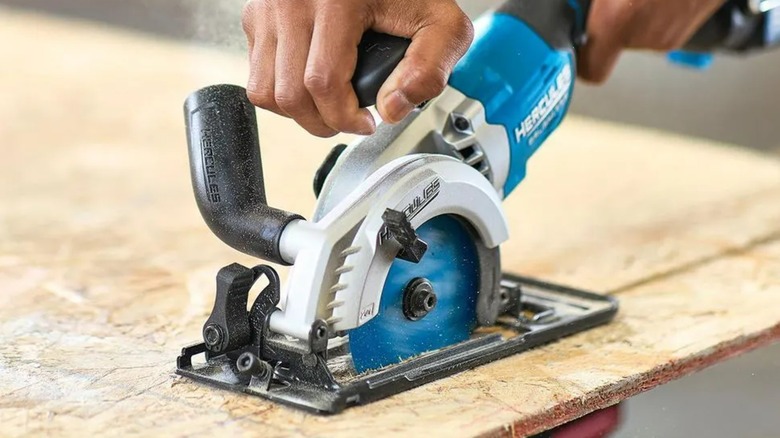
The Harbour Freight Hercules vs DeWalt Atomic cutting depth is another point of interest. With a maximum depth of 1-11/16 inches, the Hercules can comfortably clear 2x4 material in a single pass, whereas the DeWalt's slightly shallower 1.563-inch depth is a bit more restrictive. Both tools include a bevel capacity adjustment for angled cuts, ensuring versatility for trim and molding projects.
Real-World Performance: Runtime and Durability
While Hercules wins on the spec sheet for speed and depth, DeWalt generally wins the marathon. In a direct Hercules vs DeWalt compact saw battery runtime on OSB test, the DeWalt Atomic shows superior efficiency. DeWalt claims its saw can cut up to 339 linear feet of 3/4-inch OSB on a single 5.0Ah battery charge. In contrast, the Hercules is rated for approximately 250 linear feet of 1/2-inch OSB. While 250 feet is more than enough for a standard weekend project, it highlights the engineering gap in battery management and motor efficiency.
Weight and ergonomics also play a role in long-term satisfaction. Both saws weigh in the 5.5 to 5.6-pound range, but the weight distribution feels slightly more balanced on the DeWalt. However, the Hercules 20V brushless compact circular saw performance in terms of safety is neck-and-neck with its rival. Both tools feature a robust electronic blade brake that stops the blade almost instantly once the trigger is released, a critical safety feature for any one-handed power tool.

For professionals, the warranty might be the deciding factor. DeWalt offers a 3-year limited warranty, while Hercules has stepped up its game by offering a 5-year limited warranty on many of its brushless tools. This shift suggests that Harbor Freight is confident in the durability of its professional grade performance lineup. The Harbor Freight Hercules vs DeWalt Atomic specs might show minor differences, but the real-world durability is proving to be much closer than the price tag suggests.
The Value Verdict: Is It Worth the DIY Switch?
The decision between these two saws often comes down to the cordless tool ecosystem you have already started. If you already own five DeWalt batteries, spending $199 on the bare tool makes sense. However, if you are starting from scratch or need a secondary saw for light trim work, the Hercules vs DeWalt circular saw performance comparison makes a strong case for the $99 Hercules.
The Hercules 12-inch sliding miter saw, which retails for approximately $379.99, is another example of this value, often being compared to the DeWalt DWS780 which typically retails for $649. The same value proposition applies to the compact circular saws. You are getting nearly identical cutting capacities and safety features for nearly half the price.
Is Hercules 20V compact circular saw worth it for DIY? Absolutely. For the cost of one DeWalt saw, you could almost buy the Hercules saw, a battery, and a charger. Unless you are a professional contractor who needs every extra foot of runtime to finish a massive flooring job without swapping batteries, the Hercules provides more than enough power and precision for the average user.
FAQ
Is Hercules as good as DeWalt?
In many performance benchmarks, Hercules tools match or exceed the raw power and speed of DeWalt. However, DeWalt often has an advantage in battery efficiency and overall ergonomics, as well as a much larger ecosystem of specialized tools.
Are Hercules power tools professional quality?
Yes, the Hercules line is specifically marketed as the professional grade performance tier at Harbor Freight. They feature brushless motors, high-quality materials, and extended warranties designed to compete with brands like DeWalt and Milwaukee.
Are DeWalt and Hercules batteries interchangeable?
No, the 20-volt battery platform for each brand is proprietary. While they share similar voltage and lithium-ion technology, the physical connections and electronic communication protocols prevent them from being used interchangeably.
Is the Hercules 20V circular saw worth the price?
At roughly $99, the Hercules saw is widely considered one of the best values in the compact saw market. It offers the same core technology as premium competitors for about half the cost.
How does Hercules performance compare to DeWalt?
Hercules often provides higher RPM and deeper cutting capacities. DeWalt typically offers better runtime per charge and a more refined feel during extended use, though the performance gap has narrowed significantly in recent years.