Quick Facts
- Hallucination Risk: Currently sits at 28.6% in advanced models without specific constraints.
- Workload Reduction: Implementation of agentic workflows can reduce manual research tasks by 60-65%.
- Top Reasoning Model: The OpenAI o3 model, released in February 2025, leads in complex data synthesis.
- Verification Standard: A minimum of 3 independent, reputable sources is required for high-confidence claims.
- Thread Decay: Data reliability significantly drops as the chat thread length increases beyond the context window.
- Publication Volume: AI-related research papers on arXiv surged to 58,285 in 2024.
To improve AI research accuracy, use instruction prompts that specify reputable publications while explicitly excluding social media, forums, and unsourced blogs. Defining a clear research objective and using custom instructions helps the model maintain focus on high-quality data.
The digital landscape is currently witnessing an unprecedented explosion of technical literature. Between 2022 and 2024, the annual number of AI-related research papers published on arXiv increased from 35,516 to 58,285 in 2024. For the modern researcher, this volume represents both a goldmine and a minefield. While Large Language Models (LLMs) offer a way to navigate this sea of data, they are not infallible. Recent studies show that models used for scientific literature synthesis have shown hallucination rates as high as 28.6% for more advanced versions when identifying citations. Mastering AI research prompts is no longer a luxury; it is a professional necessity to bridge the gap between rapid data collection and factual integrity.

Level 1: Instructional Prompting & Source Filtering
The first step in securing high-quality information is to move beyond casual conversation. Most users treat AI like a search engine, but a professional researcher treats it like a junior analyst who needs strict boundaries. The core of this level involves implementing negative constraints. By explicitly telling the model what to avoid, you filter out the noise of the internet. Effective AI research prompts for reputable news sources should include instructions to ignore user-generated content platforms like Reddit, Quora, or niche forums that lack editorial oversight.
Instead of asking a broad question, your prompt should act as a filter. For example, when seeking market trends, you might instruct the model to prioritize reports from McKinsey, Gartner, or academic journals while using prompts to exclude social media from AI search results. This methodology ensures that the initial retrieval phase is grounded in curated, professional data rather than anecdotal evidence.
Another critical component is the failure state instruction. You must give the AI "permission" to be unsuccessful. A common prompt addition is: If no reputable source is found, state sources limited rather than speculating. This significantly aids in hallucination mitigation by preventing the model from filling information gaps with plausible-sounding but fabricated details. This is the first line of defense in how to verify AI sources at the point of generation.
- Whitelisting: Specify organizations like Nature, The Lancet, or Ars Technica.
- Negative Constraints: Explicitly ban SEO-spam blogs and community-driven wikis.
- Objective Setting: Clearly state the intended use of the data to help the model weigh source relevance.
Level 2: Mastering ChatGPT Deep Research & Agentic Workflows
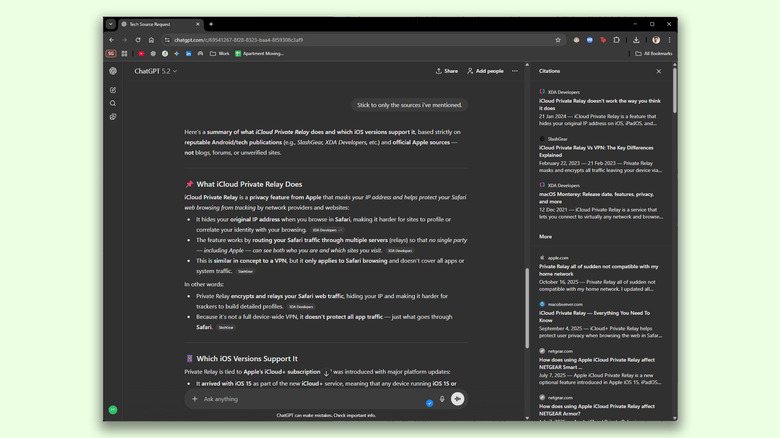
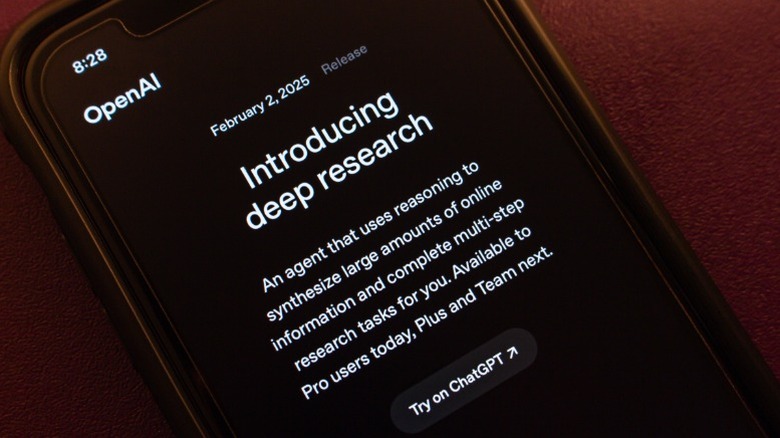
As we transition into 2025 and 2026, the shift from linear chatting to agentic workflows has become the gold standard for industry analysis. Unlike standard search, agentic models like the o3 reasoning model do not just find a link; they perform autonomous data synthesis across hundreds of sources. To maximize these features, you must provide a prompt that clearly defines the research objective and allows the AI to function as a research analyst.
One of the most significant challenges in long-form research is context window drift. As a chat session grows longer, the model may lose track of the original high-quality constraints established at the beginning. Managing AI chat context for high quality research requires a disciplined approach: if results become inconsistent or the AI begins to reference low-quality sources it previously ignored, starting a new session is the most effective way to maintain source integrity.
When using ChatGPT Deep Research tips for industry analysis, focus on objective-oriented prompting. Instead of asking for a summary of a topic, define the parameters of the synthesis. For instance, ask the model to identify conflicting viewpoints between three specific white papers. This forces the model into a reasoning state rather than a simple retrieval state, which is essential for identifying nuances in complex fields.
| Feature | Standard AI Search | Agentic Deep Research (o3/o1) |
|---|---|---|
| Search Depth | Top 5-10 Google results | 100+ multi-layered sources |
| Logic | Keyword matching | Reasoning-based synthesis |
| Verification | Single-pass retrieval | Iterative fact-checking |
| Primary Risk | Shallow hallucinations | Context window drift |
| Best Use Case | Quick definitions | Comprehensive industry analysis |
Level 3: Professional Verification Protocols
The final level of mastery is understanding that AI-generated output is a draft, not a finished product. Improving AI research accuracy requires a rigorous post-generation verification protocol. Even with the best AI research prompts, the risk of misinterpretation remains. A professional standard involves a 15-minute human verification checklist for every major claim made by the model.
Start by checking the provided citations. Ensure that links are active and, more importantly, that the information in the AI summary actually matches the original source text. Often, an AI might correctly identify a peer-reviewed literature source but slightly misinterpret a statistic or a causal relationship. Professional researchers use RAG-based tools—Retrieval-Augmented Generation—to upload specific documents and force the AI to analyze them exclusively. This reduces the risk of external hallucinations by tethering the model to a known data set.
To truly master how to verify AI sources for factual accuracy, you should adopt a cross-referencing mindset. No single AI claim should be accepted unless it can be verified by three independent sources. This is particularly important for citation verification in fast-moving fields like technology or medicine, where the 2026 benchmarks might contradict older data currently in the model's training set.
FAQ
How do you write effective prompts for AI research?
Effective prompts should include a clear persona, a specific objective, and a list of constraints. Begin by telling the AI to act as a senior research analyst. Specify the types of sources it must use, such as academic databases and official white papers, and explicitly list sources to avoid, such as social media or forums. Finally, instruct the model to provide direct citations for every claim and to state if it cannot find reliable information rather than guessing.
What are the best AI prompts for academic literature reviews?
The best prompts for literature reviews utilize Retrieval-Augmented Generation by having the user upload specific PDFs for analysis. A high-quality prompt would be: Analyze the attached papers to identify common methodologies, conflicting results, and consensus on the primary research question. Direct the AI to create a comparison table of findings and highlight the sample sizes used in each study to ensure scientific rigor.
Are there specific AI prompts for data analysis in research?
Yes, for data analysis, prompts should focus on logical verification and step-by-step reasoning. Ask the AI to describe its analytical process before providing the final result. For example: Using the provided data set, calculate the year-over-year growth and explain the formula used. Then, perform a sensitivity analysis to show how a 10% change in the primary variable would impact the outcome. This transparency allows you to check for calculation errors.
What are examples of prompts for citation management in AI?
To manage citations effectively, use prompts that enforce specific formatting and verification. An example is: For every fact presented, provide a full citation in APA format including a direct URL. If a URL is not available, provide the DOI. If the source is behind a paywall, summarize the abstract and clearly label it as such. This makes the manual verification process much faster for the human editor.
How do you prompt an AI to identify research gaps?
To find research gaps, ask the AI to perform a meta-analysis of recent publications. Use a prompt like: Review the findings of the five most recent papers on this topic and identify areas where the authors mention limitations or suggest future research. Highlight any contradictions between these studies that suggest a need for further investigation. This helps in pinpointing where original research is most needed.